
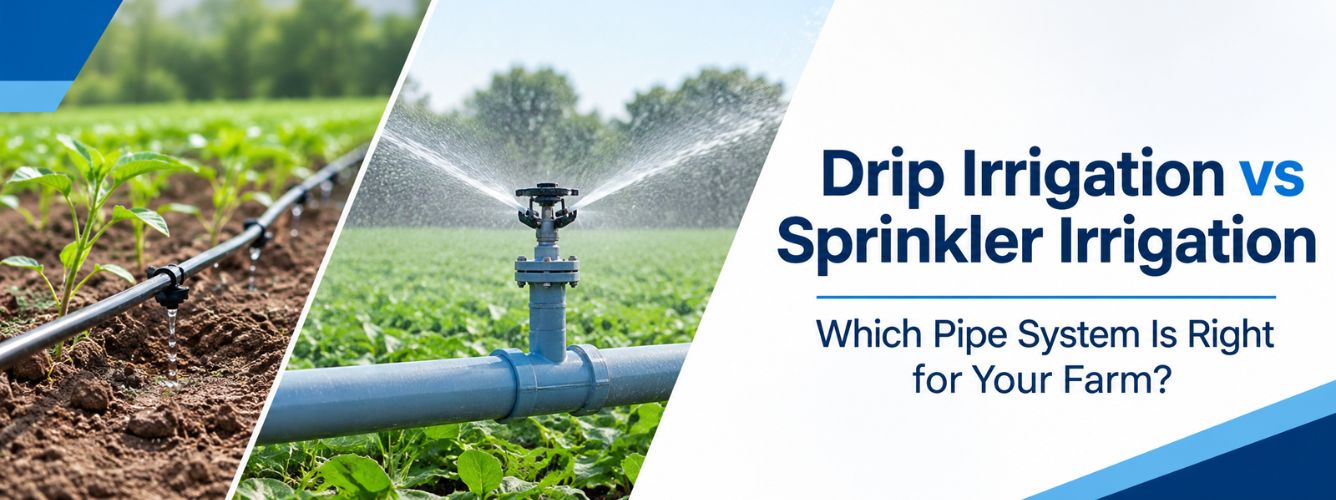
Have you ever wondered whether your farm would benefit more from drip irrigation or sprinkler irrigation?
Both methods of irrigation can deliver water to crops, but they work differently. Drip irrigation delivers water slowly and close to the crop roots, while sprinkler irrigation distributes water over a wider area.
So, which one is better for your farm? The answer depends on your crops, soil, water availability, field conditions, and how you need to distribute water across the field. Not only that, but the choice also affects the type of agricultural pipes and fittings needed to build and support the irrigation system.
So, let’s look at how drip and sprinkler irrigation work, how they compare, and what you should consider before choosing one for your farm.
Table of Contents
ToggleHow Does Drip Irrigation Work?
Drip irrigation moves water from the source through a network of agricultural pipes and fittings before delivering it in small, controlled amounts near the crop roots. The water first enters the mainline, moves into submains and laterals, and finally reaches the plants through emitters.
Each part of the drip irrigation pipes and fittings has a specific role in moving and controlling the water:
- Mainline: Carries water from the source towards the irrigated area.
- Submain: Divides the water supply between different sections of the field.
- Laterals: Carry water along individual crop rows.
- Emitters: Release water at controlled flow rates near the plants.
- Filters: Remove suspended particles from the irrigation water before they reach the emitters and potentially cause blockages.
- Pressure regulators: Control water pressure so the system can operate within the required range.
The final stage is where drip irrigation differs most from sprinkler irrigation. During drip irrigation, the emitters deliver water close to the crop’s root zone instead of releasing it into the air. The agricultural pipes and fittings connecting these components therefore form an important part of how water reaches each crop row. This can reduce water losses from wind drift and evaporation compared with many sprinkler systems.
How Does Sprinkler Irrigation Work?
Sprinkler irrigation moves water from the source through a network of agricultural pipes and fittings before distributing it over the crop or soil surface. The water travels through the mainline, moves into submains and branch lines, and finally reaches the sprinkler units.
Each part of the sprinkler irrigation pipes and fittings has a specific role in moving and distributing the water:
- Mainline: Carries water from the source towards the irrigation area.
- Submain: Distributes water from the mainline to different sections of the field.
- Branch lines: Carry water from the submains to individual sprinkler units.
- Sprinklers or nozzles: Break the water into droplets and distribute it across the target area.
- Pumps: Provide the pressure needed to move water through the system when the available source pressure is insufficient.
- Pressure regulators: Help maintain suitable operating pressure for consistent sprinkler performance.
The final stage is where sprinkler irrigation differs most from drip irrigation. Instead of delivering water directly near individual plant roots, sprinklers distribute water over a wider area through a spray pattern that resembles rainfall.
The agriculture pipes and fittings connecting the different sections of the system help carry the required flow to the sprinkler units. This makes sprinkler irrigation suitable when broader field coverage is required.
Drip Irrigation vs Sprinkler Irrigation: Side-by-Side Comparison
Drip irrigation is usually the better choice when crops need water delivered close to their roots with precise control. Sprinkler irrigation is often more suitable when the entire crop area needs to receive water from above.
The choice becomes more important when the farm has specific soil, crop, water, or field conditions. A row of widely spaced plants may benefit from targeted drip application, while a closely planted field may need the broader coverage that sprinklers provide. Wind, soil infiltration, available water, operating pressure, and crop spacing can also affect how well each method performs.
These differences also determine how the irrigation network needs to be planned. Drip irrigation uses laterals and emitters to deliver water along crop rows, while sprinkler systems use branch lines and sprinkler units to distribute water across the field. The agriculture pipes and fittings connecting these components must therefore support the required flow, pressure, field layout, and connections.
So, choosing between drip and sprinkler irrigation is not simply about deciding how water should be applied. It is about matching the irrigation method to the way your farm grows crops and uses water.
The table below brings these factors together so you can compare both systems side by side.
| Factor | Drip Irrigation | Sprinkler Irrigation |
| How water is applied | Water is delivered near the root zone through emitters. | Water is sprayed over the crop or soil surface. |
| Primary advantage | Precise, localised water application. | Broad and relatively uniform field coverage. |
| Water efficiency | Generally very high when properly designed and managed. | Can be high when properly designed and operated. |
| Best suited crops | Row crops, vegetables, orchards, vines, and widely spaced crops. | Closely spaced field crops and crops suited to overhead irrigation. |
| Root-zone targeting | High. Water is directed near individual plants or rows. | Lower. Water is distributed across a wider area. |
| Wind sensitivity | Low. Water moves directly into the soil. | Higher. Wind can affect spray distribution and cause drift. |
| Soil considerations | Emitter spacing and application rate should match soil infiltration and wetting patterns. | Application rate should not exceed the soil’s infiltration capacity. |
| Pressure requirement | Requires controlled pressure for consistent emitter discharge. | Requires adequate pressure for the intended spray pattern. |
| Filtration needs | High importance because emitters can clog. | Filters may also be required to protect nozzles and maintain performance. |
| Maintenance focus | Filters, emitters, laterals, flushing, pressure, and leaks. | Sprinklers, nozzles, valves, pressure, connections, and leaks. |
| Fertigation | Well suited to controlled fertigation. | Possible with suitable equipment and management. |
| Field coverage | Localised around plants or rows. | Wider area coverage. |
| Installation considerations | Requires careful lateral and emitter layout. | Requires correct sprinkler spacing, nozzle selection, and pressure. |
| Pipe network | Mainlines, submains, laterals, emitters, filters, valves, and fittings. | Mainlines, submains, branch lines, sprinklers, valves, and fittings. |
| Initial investment | Can be higher depending on crop spacing and system complexity. | Varies by sprinkler type, coverage, pipe network, and equipment. |
| Best choice when | Precise root-zone irrigation and water control are priorities. | Broad field coverage and overhead application are suitable. |
The table shows why neither system is automatically better for every farm. Drip offers greater control over where water reaches the crop, while sprinklers can cover larger areas through overhead application.
Your final choice should therefore reflect your crop spacing, soil, water availability, field conditions, pressure requirements, installation needs, and maintenance capacity. The agriculture pipes and fittings should then be selected to match the flow, pressure, layout, and operating requirements of that irrigation system.
Which Type of Irrigation System Is Right for Your Farm?
The right irrigation system depends on how your crops are planted, how much water is available, and how water needs to reach the root zone. Drip irrigation suits farms that need precise, localised watering, while sprinkler irrigation can work better when wider field coverage is required.
Drip irrigation may be the better fit when:
- Water availability is limited.
- Crops are planted in defined rows.
- Plants need targeted root-zone irrigation.
- Orchards or widely spaced crops are being irrigated.
- Fertigation is part of the farm’s irrigation strategy.
- Wind makes overhead irrigation difficult.
Sprinkler irrigation may be the better fit when:
- Broad field coverage is required.
- Crops are closely spaced.
- Water needs to be distributed across a larger surface area.
- The soil and crop can support overhead application.
- The farm can provide the pressure needed for sprinkler operation.
- The field layout suits sprinkler spacing and movement.
A farm does not always need to use only one irrigation method. Different crops, soil conditions, or field sections may have different water requirements, making a combination of drip and sprinkler irrigation practical.
Once the irrigation method is decided, the next question is how to build the pipe network around it. The agriculture pipes and fittings need to support the required flow, pressure, connections, and field layout. The piping network you choose should help carry water from the source to the right sections of the farm without compromising the performance of the chosen irrigation system.
The better choice is not simply the system with more advantages. It is the one that fits the farm’s actual conditions and can be operated and maintained consistently.
Conclusion
Choosing between drip and sprinkler irrigation comes down to how your farm needs to receive and use water. Drip irrigation offers precise root-zone application, while sprinkler irrigation provides broader field coverage.
Once you know which method suits your crops, soil, field conditions, and water availability, the next step is building a pipe network that can support it reliably. The right agriculture pipes and fittings need to handle the required flow, pressure, connections, and field layout without compromising irrigation performance.
At KPT Pipes, we understand that reliable irrigation depends on more than selecting an irrigation method. Our piping solutions are designed to support agricultural applications where consistent water movement, durability, and dependable performance matter.
Are you planning a new irrigation system or upgrading an existing one? Explore KPT’s range of agriculture pipes and fittings to find a solution suited to your farm’s requirements.
FAQs
1. What type of water quality is needed for drip irrigation?
Drip irrigation requires careful attention to water quality because suspended particles, organic matter, algae, and mineral deposits can clog emitters. Filtration should therefore be selected according to the water source and the emitter requirements.
2. How do you choose the right pipe size for an irrigation system?
The size of agricultural pipes and fittings should be selected according to the required flow rate, operating pressure, and pipe length. You should also consider elevation changes and the number of outlets operating at the same time.
3. What happens if the water pressure is too low in an irrigation system?
Low pressure can affect how evenly water is distributed across the field using agriculture pipes and fittings. In drip irrigation, insufficient pressure can cause inconsistent emitter discharge. In sprinkler irrigation, it can affect the spray pattern and coverage.
4. Can the same irrigation system use both drip and sprinkler irrigation?
Yes, a farm can use drip and sprinkler irrigation in different areas when crops, soil conditions, or water requirements vary. A common pipe network can sometimes supply different irrigation zones, provided the hydraulic design, valves, pressure requirements, and flow rates are properly planned.
5. How often should agricultural irrigation pipes and fittings be maintained?
Maintenance frequency of agriculture pipes and fittings depends on the water source, irrigation method, operating conditions, and system design.