
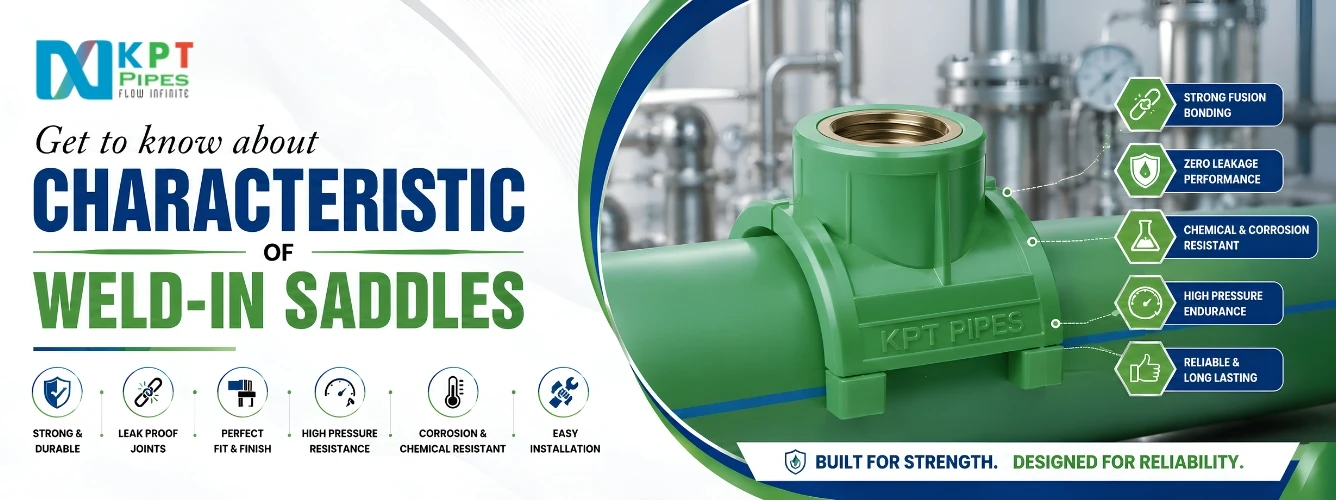
Modern plumbing and industrial piping systems demand fittings that provide secure connections, efficient water distribution, and long-lasting performance. Among the most reliable pipe fittings used in PPR piping systems is the Weld-in Saddle. It is specifically designed to create branch connections without replacing large sections of the main pipeline, making installations quicker, stronger, and more economical.
At KPT Pipes, we manufacture premium-quality PPRC Weld-in Saddles using high-grade raw materials and advanced production techniques. Every fitting is engineered to meet stringent quality standards, ensuring dependable performance across residential, commercial, and industrial applications. Our commitment to quality, durability, and innovation has made KPT Pipes a trusted manufacturer of PPR piping solutions across India.
Whether you are developing a new plumbing network or expanding an existing pipeline, Weld-in Saddles provide an efficient way to create additional outlets while maintaining the strength and reliability of the piping system.
Table of Contents
ToggleWhat is a Weld-in Saddle?
A Weld-in Saddle is a specially designed PPR fitting that allows a branch pipe to be connected directly to the main pipeline using heat fusion technology. Instead of cutting the pipe and installing additional tees or reducers, the saddle is welded onto the outer surface of the pipe to create a secure outlet.
The heat fusion process forms a homogeneous joint where both the pipe and fitting become a single integrated unit. This creates a leak-proof connection capable of handling continuous pressure, varying temperatures, and long-term operation without failure.
Because of its simple design and reliable performance, the Weld-in Saddle has become an essential fitting in modern PPR piping systems.
High-Quality PPR-C Weld-in Saddles by KPT Pipes
KPT Pipes manufactures Weld-in Saddles using premium PPR-C material that offers excellent mechanical strength, chemical resistance, and dimensional stability. Every product undergoes strict quality inspections to ensure consistent performance and long service life.
Our Weld-in Saddles are suitable for multiple piping applications, including:
- Domestic water supply systems
- Commercial plumbing projects
- Industrial fluid transportation
- Hot and cold water distribution
- HVAC installations
- Compressed air pipelines
- Agricultural irrigation systems
Each fitting is designed for easy installation and reliable operation under demanding conditions.
How Does a Weld-in Saddle Work?
The purpose of a Weld-in Saddle is to create a branch connection on an existing pipeline without disturbing the main line. The installation process involves heating both the pipe surface and the saddle using a fusion welding tool until the material reaches the appropriate fusion temperature.
Once heated, the saddle is positioned accurately on the pipeline and held firmly until cooling is complete. As the material cools, both components fuse into one solid structure, eliminating the possibility of leakage caused by mechanical joints or threaded fittings.
This heat fusion method provides a permanent connection that performs as efficiently as the original pipe itself.
Features of Weld-in Saddles
Strong Fusion Joint
Heat fusion creates a permanent molecular bond between the saddle and the pipe, ensuring excellent mechanical strength and leak-free performance.
High Temperature Resistance
PPR-C material performs exceptionally well in both hot and cold water systems. Weld-in Saddles maintain their strength even under continuous temperature variations.
Pressure Handling Capability
These fittings are designed to withstand high operating pressure, making them suitable for residential as well as industrial piping systems.
Corrosion-Free Performance
Unlike metal fittings, PPR-C Weld-in Saddles do not rust, corrode, or deteriorate due to moisture, chemicals, or mineral deposits.
Smooth Water Flow
The internal surface remains smooth throughout its service life, reducing friction losses and ensuring efficient fluid movement.
Lightweight Design
Being lightweight makes transportation, handling, and installation much easier compared to conventional metal fittings.
Long Service Life
With proper installation, Weld-in Saddles provide reliable performance for decades while requiring minimal maintenance.
Advantages of Using Weld-in Saddles
Installing a Weld-in Saddle offers several practical advantages compared to traditional branching methods.
One of the biggest benefits is reduced installation time. Since there is no need to cut and replace long sections of the pipeline, projects can be completed much faster.
Another important advantage is lower installation cost. Fewer fittings, reduced labor, and quicker installation all contribute to significant project savings.
The heat fusion connection eliminates the need for adhesives, rubber seals, or threaded joints, resulting in a cleaner and stronger piping system.
Weld-in Saddles also reduce the number of connection points, minimizing the risk of future leakage.
Because they occupy less space than conventional fittings, they are ideal for compact plumbing layouts where installation space is limited.
Installation Process of Weld-in Saddles
Proper installation is essential to achieve maximum performance.
Step 1: Mark the Branch Location
Identify the exact location on the main pipeline where the branch connection is required.
Step 2: Drill the Opening
Create an accurately sized hole using the appropriate drilling tool to match the saddle dimensions.
Step 3: Heat the Components
Use a PPR fusion welding machine to heat both the pipe surface and the Weld-in Saddle according to the recommended fusion temperature.
Step 4: Join the Saddle
Position the heated saddle carefully over the prepared opening and apply consistent pressure.
Step 5: Allow Cooling
Hold the fitting in position until the joint cools naturally. Once cooled, the fusion joint becomes permanent and ready for service.
Professional installation ensures maximum strength and long-term reliability.
Common Applications of Weld-in Saddles
Because of their versatility, Weld-in Saddles are widely used across numerous industries.
Residential Plumbing
Used to create additional water supply lines for kitchens, bathrooms, washing areas, and overhead water tanks.
Commercial Buildings
Suitable for office complexes, shopping malls, hotels, hospitals, and educational institutions requiring extensive plumbing networks.
Industrial Plants
Ideal for manufacturing units where reliable fluid transportation and branching systems are required.
HVAC Systems
Used in heating and cooling pipelines for efficient distribution of water and other compatible fluids.
Agricultural Irrigation
Provides reliable branch connections for irrigation pipelines without interrupting the primary water supply.
Water Distribution Networks
Useful in municipal and infrastructure projects where multiple branch connections are required across long-distance pipelines.
Why Choose KPT Pipes Weld-in Saddles?
KPT Pipes has established itself as a trusted manufacturer by consistently delivering reliable PPR piping products built for modern infrastructure.
Our Weld-in Saddles are manufactured using carefully selected raw materials that comply with industry quality standards. Every product is designed for dimensional accuracy, easy installation, and dependable long-term performance.
Customers choose KPT Pipes because we focus on:
- Premium quality PPR-C material
- Precision manufacturing
- Leak-proof fusion compatibility
- Excellent pressure and temperature resistance
- Long operational life
- Consistent product quality
- Wide range of available sizes
- Reliable customer support
Whether your project is residential, commercial, or industrial, KPT Pipes provides piping solutions that deliver lasting value and performance.
Available Sizes
KPT Pipes offers Weld-in Saddles in multiple dimensions to suit different pipeline requirements. Standard sizes generally range from 40 mm to 160 mm, making them suitable for various plumbing and industrial installations.
Our product range includes:
- Weld-in Saddle
- Weld-in Saddle Female
- Weld-in Saddle Reducer
Each fitting is manufactured with precision to ensure compatibility with PPR piping systems and easy fusion welding.
Conclusion
Weld-in Saddles have become an essential component of modern PPR piping systems because they offer a practical, durable, and cost-effective solution for creating branch connections. Their heat fusion installation method provides exceptional strength while eliminating common issues associated with traditional mechanical fittings.
By choosing KPT Pipes Weld-in Saddles, customers receive high-quality products engineered for durability, safety, and long-term performance. Whether you are expanding an existing pipeline or constructing a completely new plumbing system, our fittings help ensure reliable water distribution with minimal maintenance and maximum efficiency.
Explore the complete range of KPT Pipes PPR fittings to find the ideal solution for your plumbing, industrial, and infrastructure projects.
Frequently Asked Questions (FAQs)
Q1. What is the purpose of a Weld-in Saddle?
Ans: A Weld-in Saddle is used to create a branch connection on an existing PPR pipeline without replacing the main pipe, providing a strong and leak-proof outlet.
Q2. Are Weld-in Saddles suitable for hot water systems?
Ans: Yes. PPR-C Weld-in Saddles are designed to perform efficiently in both hot and cold water applications while maintaining their strength and durability.
Q3. What is the joining method used for Weld-in Saddles?
Ans: They are installed using heat fusion welding, where the pipe and fitting are heated and fused together to form a permanent connection.
Q4. Where are Weld-in Saddles commonly used?
Ans: They are widely used in residential plumbing, commercial buildings, industrial piping systems, HVAC installations, and agricultural irrigation networks.
Q5. Why should I choose KPT Pipes Weld-in Saddles?
Ans: KPT Pipes offers precision-engineered Weld-in Saddles made from high-quality PPR-C material, ensuring leak-proof performance, corrosion resistance, long service life, and compliance with industry standards.