
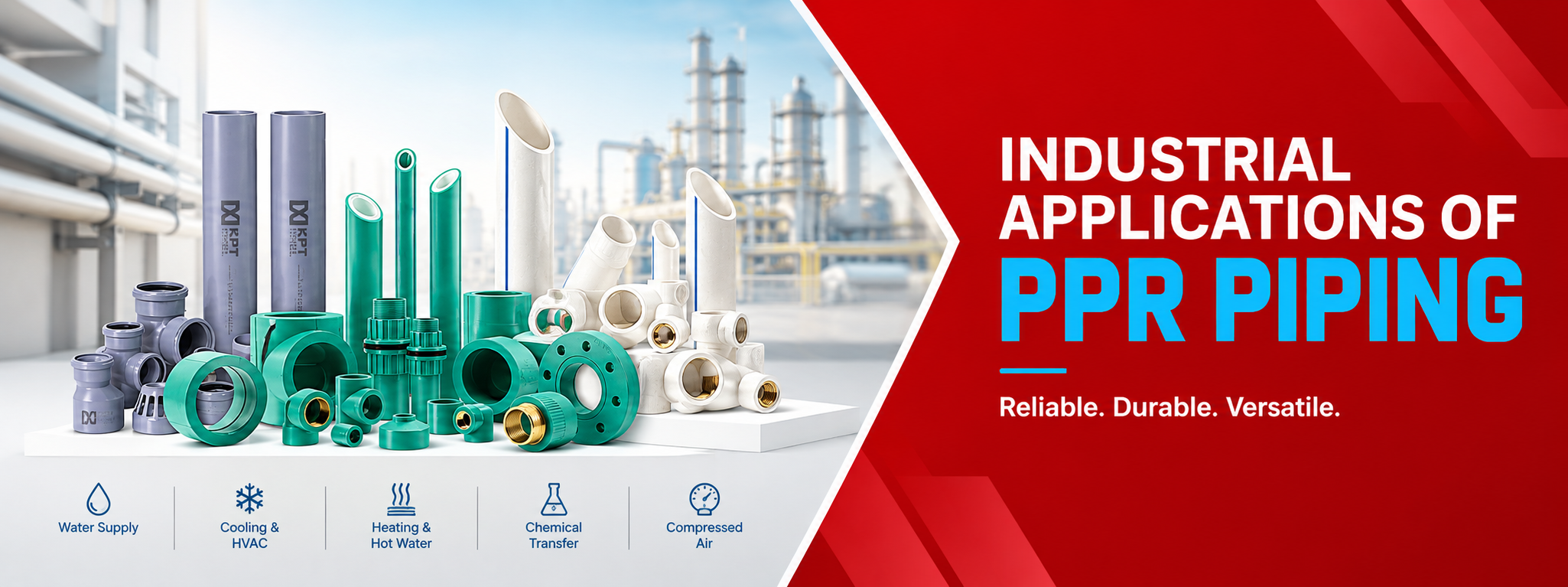
Industrial piping has to do much more than move fluids from one point to another. It needs to handle the conditions of the process, remain dependable over time, and fit the way a facility actually operates. That is one reason PPR industrial pipes are gaining attention across industrial projects.
Made from polypropylene random copolymer, PPR offers a combination of properties that can suit different piping requirements. It can handle hot and cold water, resist corrosion, and use heat-fused joints to create a continuous piping system. But is that why PPR piping is gaining so much importance? Actually, versatility is the bigger reason behind the popularity of PPR piping in industrial applications
The same basic PPR technology can be used for water distribution, cooling, heating, selected process fluids, chemical services, and compressed air. Yes, the requirements change from one application to another, but PPR can be specified to suit many of these systems.
So, are you considering PPR piping for your next industrial project? It helps to first understand where it fits and, more importantly, why it fits. Here are six common industrial applications of PPR piping and the requirements that make it suitable for each.
Table of Contents
Toggle1. Industrial Water Supply
Industrial facilities need water for much more than drinking or sanitation. Water can support production, cleaning, equipment operation, and several day-to-day plant activities. The piping system must therefore distribute water reliably from the source or treatment system to different points across the facility. This can include main distribution lines, branch connections, equipment connections, and other utility points.
PPR industrial pipes fit this application because:
- They resist corrosion
Polypropylene does not face the same corrosion concerns associated with conventional metallic piping. This makes it suitable for water distribution networks where long-term material performance matters.
- They have a smooth internal surface
A smooth bore can support consistent water flow through the distribution network and reduce the surface conditions that contribute to deposits.
- They use heat-fused joints
PPR pipes and fittings are generally joined through heat fusion. When correctly installed, the process creates a continuous connection between the pipe and fitting.
- They have defined requirements for water applications
In India, IS 15801:2008 specifies requirements for polypropylene-random copolymer pipes used for hot and cold water supplies within its scope. The standard covers dimensions, hydraulic characteristics, fusion compatibility, impact strength, and thermal stability.
Together, these characteristics make PPR a practical option for industrial water networks that need corrosion resistance, consistent flow, reliable connections, and performance suited to their operating conditions.
2. Industrial Cooling and HVAC Systems
Did you know industrial equipment generates heat during operation? Yes, so industries use cooling systems to remove that heat by circulating water between the equipment and a cooling source. The water then absorbs heat from the equipment, carries it away, and returns after being cooled again.
Since this cycle continues throughout the operation, the industrial piping needs to keep the water moving while handling temperature changes and system pressure. That makes the choice of piping material an important part of the cooling system. PPR industrial pipes fit these cooling and HVAC applications for several reasons:
- They resist corrosion
Polypropylene can withstand corrosion-related issues that may affect some conventional metallic piping. This makes it suitable for cooling-water circulation where the system operates continuously.
- They have low thermal conductivity
PPR transfers less heat through the pipe wall than many metals. This can help limit unwanted heat transfer through the piping.
- They have a smooth internal surface
The smooth bore allows water to move through the network with less surface resistance, supporting continuous circulation.
- They are used for different cooling-water duties
PP-R and PP-RCT systems are used for chilled-water and condenser-water applications, including cooling towers and other cooling services.
Note that the exact requirements for piping can still differ from one cooling system to another. Chilled water, condenser water, and industrial cooling water may operate at different temperatures and pressures. The selected PPR system therefore needs to match the actual conditions of the cooling circuit.
3. Industrial Heating and Hot-Water Systems
Many industries need hot water or heat-transfer fluid as part of their operations. Food processing plants, chemical facilities, and pharmaceutical manufacturers, for example, may use heated water for production, cleaning, or process heating.
These systems need piping that can carry heated water continuously while maintaining its performance under operating pressure. This is where PPR industrial pipes have found a place.
PPR piping is known to handle defined hot-water and heating applications when its temperature and pressure ratings match the system. This means the piping can be used for processes where heated water needs to circulate continuously, provided the selected system is rated for those operating conditions.
Its smooth internal surface offers another benefit. It allows water to move through the piping with less surface resistance, which supports continuous circulation through the heating system.
Moreover, did you know that ISO 15874 also covers polypropylene piping systems for defined hot-water and heating applications? The standard considers application classes along with design temperatures and pressures, giving manufacturers and engineers a defined basis for selecting PP piping for these services.
All this makes PPR a practical option for industrial processes that depend on continuous hot-water circulation. But always remember to check if the piping system matches the required service conditions.
4. Industrial Process Water and Fluid Transfer
Water used in a factory is not always meant for general plant use. In many industries, it becomes part of the manufacturing process itself. Food manufacturers, for instance, may use it for washing and processing, while pharmaceutical and chemical facilities may need it at different stages of production.
That changes what the industrial piping needs to do. It must move water from treatment or storage systems to production equipment while maintaining the flow and conditions the process requires. The network may include main lines, branch connections, equipment feeds, and return lines. That’s exactly where PPR industrial pipes fits in because:
- Polypropylene resists corrosion that can affect conventional metallic piping, making it suitable for continuous process-water circulation.
- Its smooth internal surface allows water to move through the network with less resistance, supporting consistent flow between process points.
- It can be joined through heat fusion, creating continuous connections across the distribution and transfer network.
This is why industries such as food processing, pharmaceuticals, and chemical manufacturing are using PPR piping for selected industrial process water and fluid transfer.
5. Chemical and Compatible Process-Fluid Transport
Chemical manufacturing involves moving liquids between storage tanks, dosing systems, mixing units, and processing equipment. The piping used for these transfers needs to withstand regular contact with the fluids moving through the system.
Polypropylene offers resistance to many acidic and alkaline solutions. This makes PPR useful for transferring chemical solutions through different stages of an industrial process without the corrosion concerns associated with some conventional metallic piping.
PPR industrial pipes also offer a smooth internal surface, which supports the movement of process fluids through the piping network. Its heat-fused joints create continuous connections between pipes and fittings, making it suitable for transfer lines across different areas of a plant.
Moreover, PPI identifies PP-R and PP-RCT for industrial and process piping used in chemical processes. Hence, PPR piping use has become important in chemical manufacturing, where piping needs to handle chemical fluids while supporting continuous movement through the production system.
6. Compressed-Air and Pneumatic Systems
Walk through a manufacturing plant, and you will find compressed air supporting many everyday operations. It can power pneumatic tools, operate actuators, and run automated production equipment. Piping networks are responsible for carrying this air from the compressor to machines and workstations across the facility.
But you cannot rely on just any industrial piping for this job. The system needs to carry pressurised air through the plant while maintaining steady airflow across different points of use. It also needs to work across the main header, branch lines, and equipment connections that make up the network.
This is where PPR-based pneumatic systems can fit into industrial compressed-air applications. Their smooth internal surface supports airflow through the network, while the lightweight polypropylene construction makes the system easier to handle and install across the facility.
That makes PPR industrial pipes important for manufacturing environments where compressed air is part of daily production. It provides a practical way to distribute pressurised air from the compressor to the equipment that depends on it.
Conclusion
PPR piping has a place across several industrial systems, from water supply and cooling to heating, process fluids, chemical transfer, and compressed air. Each application uses the piping for a different purpose, but the reason for choosing it comes down to how well its properties suit the job.
That makes PPR industrial pipes worth considering when you are planning or upgrading an industrial piping system. They can offer the performance, durability, and versatility needed across different plant requirements. So, are you planning to buy PPR piping for your industrial property?
KPT’s Greentherm Pipes are designed for industrial and commercial applications, including cooling, heating, process systems, and selected chemical applications. Built around PPR-C technology, Greentherm Pipes have become a trusted choice for industries looking for dependable piping solutions.
Contact us when seeking the best PPR piping in India.
FAQs
1. Where are PPR pipes commonly used in industrial applications?
PPR pipes are used for industrial water supply, cooling, heating, process fluids, chemical transfer, and compressed-air systems.
2. Why are PPR pipes used in industrial piping systems?
PPR offers corrosion resistance, smooth internal surfaces, and heat-fused joints, making it suitable for several industrial piping requirements.
3. Can PPR pipes be used for compressed-air systems?
Yes, Purpose-designed PPR pneumatic systems can distribute compressed air through industrial facilities, including main headers, branch lines, and equipment connections.