
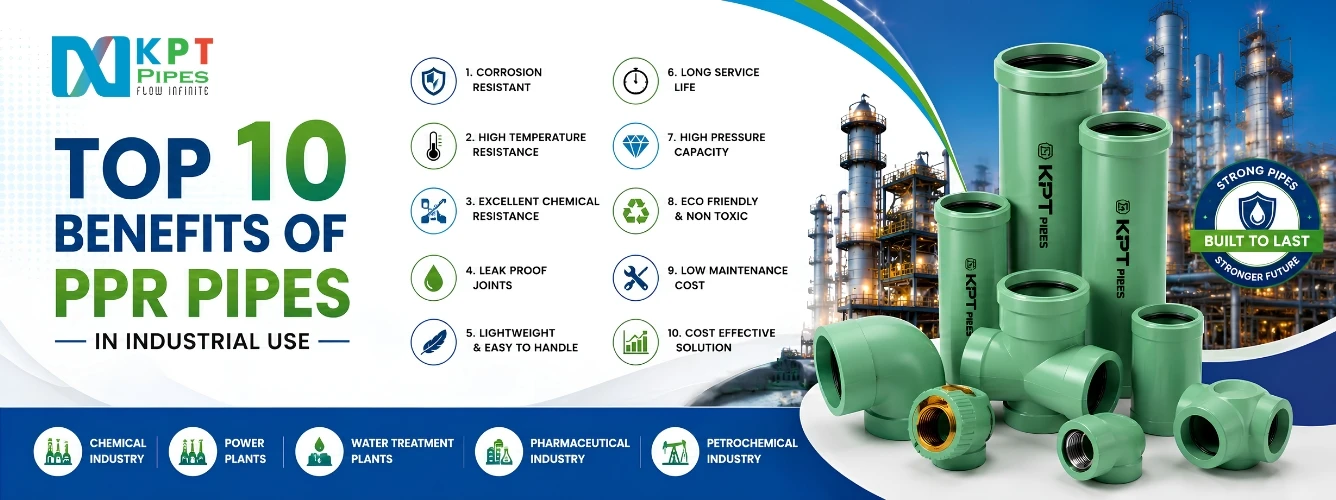
Modern industries demand piping systems that can handle challenging environments while maintaining efficiency, safety, and durability. From manufacturing plants and chemical industries to food processing facilities and HVAC systems, the choice of piping material directly impacts operational performance. Among the various options available today, PPR Pipes (Polypropylene Random Copolymer Pipes) have emerged as one of the most reliable and cost-effective solutions.
Known for their strength, resistance to corrosion, and long service life, PPR pipes are increasingly replacing conventional metal and plastic piping systems. Their ability to withstand high temperatures, pressure fluctuations, and chemical exposure makes them an ideal choice for industrial applications. Below are ten key advantages that make PPR pipes a preferred option across multiple industries.
Table of Contents
Toggle1. Long Service Life and Outstanding Durability
One of the biggest advantages of PPR pipes is their exceptional lifespan. Manufactured using advanced polypropylene material, these pipes are designed to withstand continuous industrial usage without compromising performance.
Unlike metal pipes that may rust or deteriorate over time, PPR pipes remain structurally stable for decades. Their resistance to wear, environmental stress, and mechanical damage significantly reduces the risk of premature failure. When installed correctly, PPR piping systems can serve industrial facilities for more than 50 years, making them a highly economical long-term investment.
2. Excellent Performance Under High Temperatures
Industrial operations often involve the transportation of hot water, steam-related fluids, and temperature-sensitive materials. PPR pipes are specifically engineered to perform efficiently under elevated temperatures.
They can handle continuous hot water applications and maintain their shape and strength even when exposed to high thermal conditions. This makes them suitable for heating systems, industrial processing plants, and hot-water distribution networks. Their ability to resist thermal stress ensures consistent performance without cracking or deformation.
3. Superior Resistance to Chemicals
Many industries work with aggressive chemicals that can damage traditional piping systems. PPR pipes offer excellent resistance against a wide range of chemical substances, including acids, alkalis, and industrial solvents.
This chemical stability prevents corrosion and contamination within the pipeline. As a result, industries such as pharmaceuticals, chemical manufacturing, and water treatment facilities can safely transport sensitive liquids without affecting product quality. The non-reactive nature of PPR pipes and fittings also helps maintain system efficiency over extended periods.
4. Leak-Free Jointing System
Leakage is one of the most common causes of operational losses and maintenance expenses in industrial facilities. PPR pipes address this issue through a heat fusion welding process that creates a strong and homogeneous connection between pipes and fittings.
Unlike threaded or glued joints, fused connections become an integral part of the piping system. This significantly reduces the possibility of leaks and joint failures. The result is a secure pipeline network that ensures uninterrupted fluid flow while minimizing maintenance requirements and operational risks.
5. Lightweight Yet Strong Construction
Despite their impressive strength, PPR pipes are remarkably lightweight compared to traditional metal piping systems. This feature simplifies transportation, handling, and installation.
Workers can install PPR pipes more quickly without requiring heavy machinery or extensive labor resources. Their lightweight design also reduces structural load on buildings and support systems. For industries looking to optimize project timelines and installation costs, PPR pipes provide a practical and efficient solution.
6. Energy Efficiency Through Thermal Insulation
Heat loss can significantly increase operational costs in industrial systems. One of the lesser-known benefits of PPR pipes is their natural thermal insulation capability.
Unlike metal pipes that rapidly transfer heat, PPR pipes help maintain fluid temperatures for longer periods. This reduces the need for additional insulation materials and lowers energy consumption. Whether used in hot water systems or temperature-controlled industrial processes, PPR pipes contribute to improved energy efficiency and reduced utility expenses.
7. Corrosion-Free Operation
Corrosion remains a major challenge for metal piping systems, particularly in environments exposed to moisture, chemicals, or fluctuating temperatures. Over time, corrosion can weaken pipelines, contaminate fluids, and increase maintenance costs.
PPR pipes eliminate this concern. Since they do not rust or corrode, they maintain smooth internal surfaces throughout their lifespan. This helps preserve flow efficiency and prevents issues such as blockages, scaling, and pressure drops. The result is a more reliable and efficient piping system.
8. Low Maintenance Requirements
Industrial facilities constantly seek ways to reduce downtime and maintenance expenditures. PPR pipes support this goal by requiring very little maintenance throughout their service life.
Their resistance to scaling, corrosion, and chemical degradation minimizes the need for regular inspections and repairs. Businesses can focus more on production activities instead of dealing with frequent pipe replacements or maintenance disruptions. This reliability leads to significant savings in both labor and operational costs.
9. Hygienic and Safe for Sensitive Applications
Industries such as food processing, pharmaceuticals, healthcare, and beverage manufacturing require piping systems that maintain high hygiene standards. PPR pipes are manufactured from non-toxic materials that do not contaminate transported fluids.
Their smooth internal surfaces discourage the buildup of bacteria, sediments, and other impurities. This helps maintain product quality and supports compliance with strict industry regulations. Because they do not release harmful substances into the fluid stream, PPR pipes are considered a safe and hygienic choice for critical applications.
10. Versatility Across Multiple Industrial Sectors
The adaptability of PPR pipes is one of the key reasons for their growing popularity. They can be used in a wide range of industrial systems, including:
- Chemical processing plants
- HVAC and air-conditioning systems
- Water treatment facilities
- Pharmaceutical manufacturing units
- Food and beverage processing industries
- Industrial hot and cold water distribution
- Compressed air systems
- Manufacturing and production facilities
Their ability to handle varying temperatures, pressures, and fluid types makes them a universal solution for diverse industrial requirements. This versatility reduces the need for multiple piping materials and simplifies inventory management.
Why Industries Prefer PPR Pipes Today
As industries continue to prioritise efficiency, sustainability, and cost reduction, PPR pipes have become an increasingly attractive choice. Their durability, leak-proof performance, corrosion resistance, and low maintenance requirements provide measurable long-term benefits.
Additionally, the growing focus on environmental responsibility has encouraged industries to adopt materials that are recyclable and energy-efficient. PPR pipes align perfectly with these objectives while delivering reliable performance in demanding industrial environments.
Conclusion
PPR pipes have transformed modern industrial piping systems by offering a combination of strength, reliability, and efficiency. Their resistance to chemicals, high temperatures, and corrosion makes them suitable for some of the most demanding industrial applications. Combined with low maintenance requirements, energy-saving properties, and long service life, these pipes provide exceptional value for businesses seeking dependable infrastructure solutions.
Whether for chemical plants, manufacturing units, HVAC installations, or food processing facilities, PPR pipes continue to prove their worth as a future-ready piping solution that supports both operational efficiency and long-term cost savings.
FAQs
Q1. What makes PPR pipes suitable for industrial applications?
Ans: PPR pipes offer excellent resistance to heat, pressure, chemicals, and corrosion, making them ideal for demanding industrial environments.
Q2. How long can PPR pipes last in industrial systems?
Ans: With proper installation and operating conditions, PPR pipes can perform efficiently for over 50 years.
Q3. Are PPR pipes resistant to industrial chemicals?
Ans: Yes, PPR pipes are highly resistant to many acids, alkalis, and chemical substances commonly used in industrial processes.
Q4. Do PPR pipes require frequent maintenance?
Ans: No. Their corrosion-free and scale-resistant properties significantly reduce maintenance and repair requirements.
Q5. Which industries commonly use PPR pipes?
Ans: PPR pipes are widely used in chemical processing, pharmaceuticals, food manufacturing, HVAC systems, water treatment plants, and industrial production facilities.