
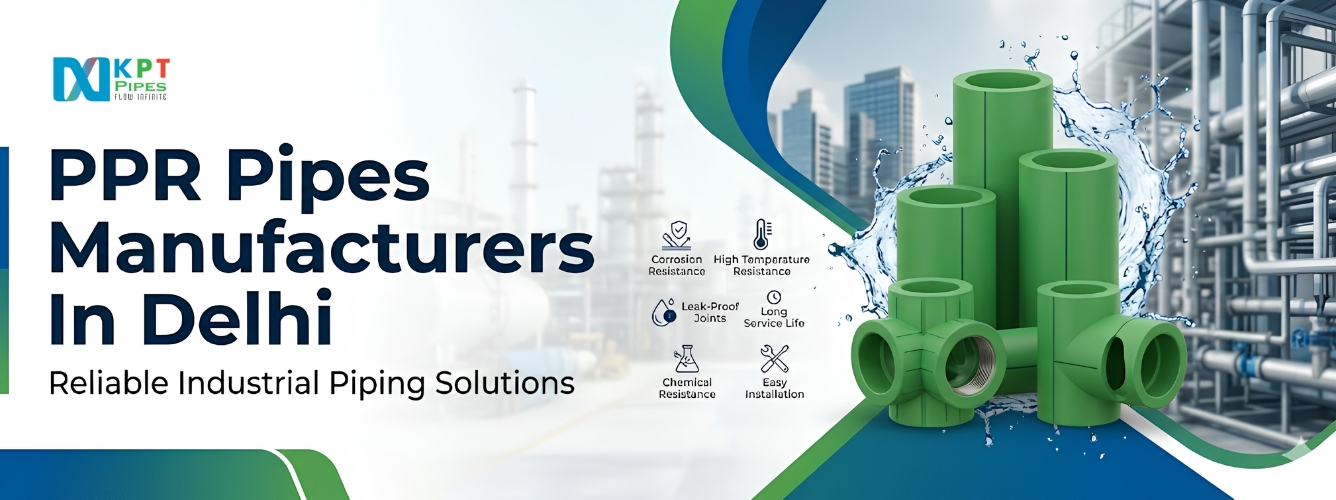
Industrial piping systems demand durability, efficiency, and long-term reliability. Whether it is water distribution, chemical transportation, HVAC installations, or manufacturing facilities, selecting the right piping material plays a crucial role in operational performance. Among the various piping solutions available today, Polypropylene Random Copolymer (PPR) pipes have emerged as one of the most trusted options for industrial applications.
Known for their exceptional strength, corrosion resistance, and long service life, PPR Pipes have become the preferred choice for engineers, contractors, and facility managers. As a leading PPR Pipes Manufacturer in Delhi, KPT Pipes offers advanced piping solutions designed to meet the requirements of modern industries.
Table of Contents
ToggleWhat Are PPR Pipes?
PPR (Polypropylene Random Copolymer) pipes are thermoplastic piping systems manufactured using high-quality polypropylene material. These pipes are joined through heat fusion technology, creating leak-proof and homogeneous joints that are often stronger than the pipe itself.
Unlike traditional metal pipes that are prone to rust and scaling, PPR pipes maintain their performance over decades while ensuring smooth water flow and minimal maintenance requirements.
Why Industries Prefer PPR Pipes
1. Outstanding Durability
Industrial environments often expose piping systems to pressure fluctuations, temperature variations, and continuous operation. PPR pipes are engineered to withstand these challenges without cracking or deforming.
Their robust construction ensures long-lasting performance, reducing repair costs and minimizing downtime in industrial operations.
2. Excellent Chemical Resistance
Many industries handle liquids containing chemicals that can corrode conventional piping materials. PPR pipes offer remarkable resistance to acids, alkalis, and various chemical compounds.
This makes them ideal for:
- Chemical processing plants
- Pharmaceutical facilities
- Food processing industries
- Water treatment plants
- Manufacturing units
3. Superior Temperature Resistance
One of the biggest advantages of PPR pipes is their ability to handle both hot and cold water systems effectively. These pipes can operate efficiently at elevated temperatures without losing structural integrity.
Their thermal stability makes them suitable for:
- Industrial hot water systems
- HVAC applications
- Boiler connections
- Heating networks
4. Leak-Free Heat Fusion Technology
Unlike threaded or adhesive joints, PPR pipes are connected using heat fusion welding. During installation, the pipe and fitting are heated and fused together to form a single continuous structure.
Benefits include:
- Zero leakage risk
- Stronger connections
- Reduced maintenance
- Enhanced system reliability
5. Long Service Life
PPR piping systems are designed to perform for more than 50 years under normal operating conditions. Their resistance to corrosion, scaling, and chemical degradation significantly extends their lifespan compared to traditional piping materials.
Understanding the Manufacturing Process of PPR Pipes
The manufacturing of PPR pipes involves advanced extrusion technology that ensures dimensional accuracy and consistent quality.
The process generally includes:
- Selection of premium polypropylene random copolymer raw material.
- Controlled melting and extrusion.
- Precision sizing and cooling.
- Quality testing for pressure and dimensional stability.
- Inspection and packaging.
At every stage, strict quality control measures are implemented to ensure the final product meets international standards.
PPR Pipes vs PVC Pipes
Both PPR and PVC pipes are widely used in plumbing and industrial systems. However, PPR pipes offer several advantages in demanding industrial environments.
| Feature | PPR Pipes | PVC Pipes |
|---|---|---|
| Temperature Resistance | High | Moderate |
| Joint Strength | Heat Fusion Welded | Solvent Cemented |
| Service Life | Up to 50 Years | Lower |
| Corrosion Resistance | Excellent | Good |
| Chemical Resistance | Excellent | Moderate |
| Hot Water Applications | Suitable | Limited |
| Maintenance Requirements | Minimal | Moderate |
For industrial applications requiring durability and long-term reliability, PPR pipes are often the preferred option.
Major Applications of PPR Pipes
Industrial Water Supply Systems
PPR pipes provide safe and efficient transportation of water throughout industrial facilities while maintaining water quality.
HVAC Systems
Their low thermal conductivity helps reduce heat loss and improve energy efficiency in heating and cooling systems.
Compressed Air Systems
The smooth internal surface reduces pressure losses, making them suitable for compressed air applications.
Chemical Transport
PPR pipes can safely transport various industrial chemicals without suffering from corrosion or contamination.
Fire Protection Networks
Specialized PPR piping systems are increasingly being used in fire suppression and firefighting installations.
Eco-Friendly and Sustainable Solution
Sustainability has become a major focus for industries worldwide. PPR pipes contribute positively to environmental goals because they are:
- Recyclable
- Non-toxic
- Energy-efficient during production
- Free from heavy metals
- Safe for drinking water systems
Their long lifespan further reduces material waste and replacement frequency, making them an environmentally responsible piping solution.
Key Features of KPT PPR Pipes
KPT Pipes focuses on delivering superior-quality piping systems that meet industrial requirements.
Strong and Reliable Construction
Designed to withstand demanding operating conditions, ensuring dependable performance for years.
Corrosion-Free Performance
Unlike metal pipes, PPR systems do not rust, scale, or corrode over time.
Lightweight Design
The lightweight nature of PPR pipes simplifies transportation, handling, and installation.
Hygienic Water Flow
The smooth internal surface prevents bacterial growth and sediment accumulation.
Energy Efficient
Low thermal conductivity helps conserve energy and improve system efficiency.
Permissible Working Pressure Table
The allowable working pressure of PPR pipes depends on factors such as temperature, service life, and pressure class.
| Temperature (°C) | Service Life (Years) | PN-10 (Bar) | PN-16 (Bar) | PN-20 (Bar) |
| 20°C | 50 | 20.4 | 31.7 | 25.7 |
| 40°C | 50 | 14.6 | 22.6 | 18.3 |
| 60°C | 50 | 10.3 | 15.9 | 12.7 |
| 70°C | 25 | 8.0 | 12.5 | 10.1 |
| 80°C | 25 | 5.2 | 8.0 | 6.4 |
| 95°C | 10 | 3.5 | 5.4 | 4.2 |
Note: Under normal operating conditions, KPT PPR piping systems are designed to provide a service life of 50 years or more.
Quality Assurance and Testing
Every KPT PPR pipe undergoes stringent quality testing before reaching customers. The testing process includes:
- Hydrostatic pressure testing
- Dimensional accuracy checks
- Raw material verification
- Impact resistance testing
- Thermal performance evaluation
This commitment to quality ensures reliable performance in critical industrial applications.
Conclusion
As industries continue to seek efficient, durable, and sustainable piping solutions, PPR pipes have become the preferred choice for modern industrial pipe fittings. Their superior temperature resistance, corrosion-free performance, leak-proof joints, and exceptional lifespan make them an ideal investment for long-term infrastructure projects.
Whether for water supply, chemical processing, HVAC systems, or industrial utilities, KPT Pipes delivers high-performance PPR piping solutions that meet the evolving demands of today’s industries.
FAQs
Q1. What does PPR stand for in piping systems?
Ans: PPR stands for Polypropylene Random Copolymer, a thermoplastic material widely used in plumbing and industrial piping systems.
Q2. How long do PPR pipes last?
Ans: Under normal operating conditions, high-quality PPR pipes can last 50 years or more.
Q3. Are PPR pipes suitable for hot water applications?
Ans: Yes, PPR pipes can handle both hot and cold water systems and are widely used in heating applications.
Q4. Why are PPR pipes preferred over metal pipes?
Ans: They are corrosion-resistant, lightweight, leak-proof, and require minimal maintenance compared to metal pipes.
Q5. Can PPR pipes be recycled?
Ans: Yes, PPR pipes are recyclable and considered an environmentally friendly piping solution.