

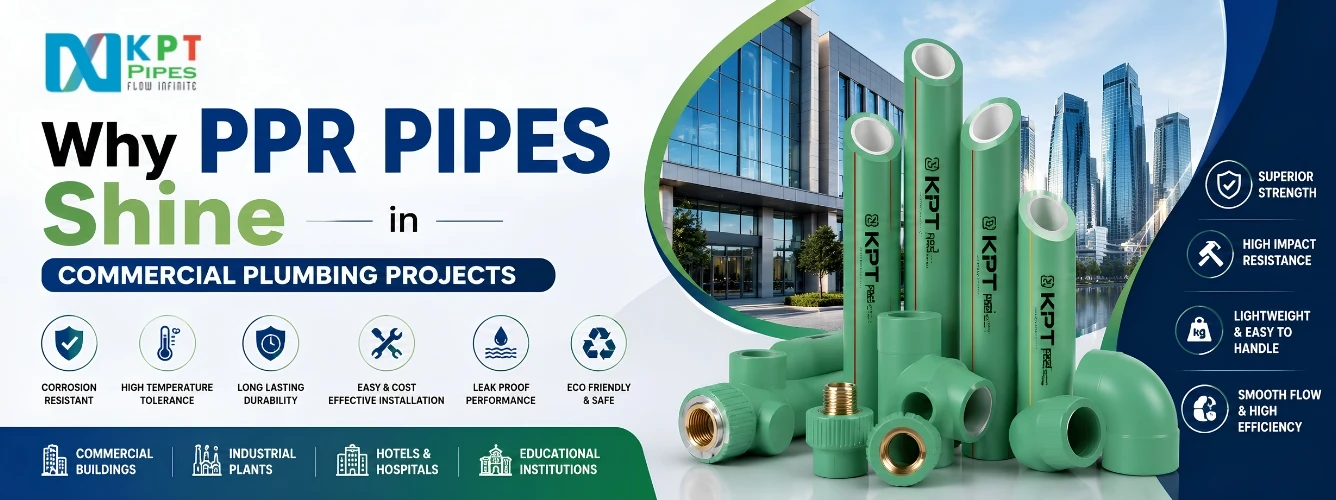
Commercial buildings demand plumbing systems that can handle high water usage, varying temperatures, and long-term operational requirements without frequent maintenance. Whether it’s an office complex, hotel, hospital, shopping mall, educational institution, or industrial facility, selecting the right piping material is essential for ensuring efficiency and durability.
Over the years, Polypropylene Random Copolymer (PPR) pipes have become one of the most trusted solutions for commercial plumbing systems. Their advanced material properties, long service life, and cost-effective performance make them a preferred choice among engineers, contractors, and building owners.
Table of Contents
ToggleUnderstanding PPR Pipes
PPR pipes are manufactured using high-grade polypropylene random copolymer, a material known for its strength, flexibility, and resistance to chemical reactions. These pipes are commonly used for hot and cold water distribution systems, HVAC applications, compressed air systems, and industrial fluid transportation.
Unlike conventional metal piping systems that can corrode or degrade over time, PPR pipes are designed to provide consistent performance for decades with minimal maintenance.
1. Exceptional Strength for High-Demand Applications
Commercial properties often operate around the clock, placing significant stress on plumbing systems. Restaurants, hospitals, factories, and large residential complexes require pipes that can withstand continuous water flow and varying pressure levels.
PPR pipes are engineered to handle demanding conditions without cracking, leaking, or losing performance. Their robust construction allows them to perform efficiently even under high pressure and temperature fluctuations.
This strength makes them suitable for:
- Commercial office buildings
- Hotels and resorts
- Healthcare facilities
- Educational institutions
- Industrial plants
With proper installation, PPR piping systems can remain functional for several decades, reducing replacement costs and operational disruptions.
2. Complete Protection Against Corrosion
One of the biggest challenges faced by traditional metal pipes is corrosion. Exposure to water, chemicals, and environmental conditions can cause rust formation, weakening the piping system over time.
PPR pipes eliminate this concern entirely. Since they are made from non-metallic materials, they do not rust, corrode, or react with most chemicals commonly found in water supply systems.
The benefits of corrosion resistance include:
- Cleaner water quality
- Reduced risk of leaks
- Longer service life
- Lower maintenance expenses
- Improved system reliability
This makes PPR pipes particularly valuable for commercial projects where uninterrupted water supply is critical.
3. Superior Water Flow Efficiency
Efficient water movement is essential in commercial buildings. Any reduction in flow can affect daily operations and increase energy consumption.
PPR pipes feature a smooth inner surface that minimizes friction and prevents the accumulation of deposits. Unlike some traditional materials that become rough with age, PPR pipes and fittings maintain their smoothness throughout their lifespan.
As a result:
- Water pressure remains stable
- Flow rates stay consistent
- Pumping energy is reduced
- Blockages become less frequent
For large commercial properties, this translates into improved operational efficiency and lower utility costs.
4. Excellent Performance in Hot and Cold Water Systems
Commercial buildings often require both hot and cold water distribution. Hotels, hospitals, and manufacturing units especially depend on plumbing systems capable of handling varying temperatures.
PPR pipes are specifically designed to perform effectively across a wide temperature range. They maintain structural stability even when transporting hot water continuously.
Key advantages include:
- Resistance to thermal stress
- Minimal expansion and contraction
- Reliable hot water transportation
- Reduced chances of pipe damage
Their ability to manage temperature fluctuations makes them a dependable option for modern commercial infrastructure.
5. Energy-Saving Thermal Insulation Properties
Energy efficiency has become a major focus in today’s construction industry. PPR pipes contribute to energy conservation through their natural insulating properties.
Unlike metal pipes that quickly transfer heat, PPR pipes reduce heat loss during water transportation. This helps maintain the desired water temperature for longer periods.
Benefits include:
- Reduced heating costs
- Improved energy efficiency
- Better temperature retention
- Enhanced system performance
For commercial buildings seeking sustainable operations, these energy-saving characteristics provide significant long-term value.
6. Leak-Proof Jointing Technology
One of the standout features of PPR piping systems is their heat fusion joining method. Instead of relying on mechanical joints, adhesives, or threading, PPR pipes are joined using fusion welding.
This process creates a permanent connection where the pipe and fitting become a single unit.
Advantages of fusion joints include:
- Virtually leak-free performance
- Increased system strength
- Improved reliability
- Lower maintenance requirements
In commercial projects where leaks can lead to costly repairs and downtime, this technology offers valuable peace of mind.
7. Faster Installation and Reduced Labour Costs
Construction schedules are often tight, making installation efficiency a crucial consideration.
PPR pipes are lightweight and easy to transport, handle, and install. Their fusion welding process is straightforward and significantly faster compared to many traditional piping systems.
This results in:
- Reduced installation time
- Lower labor expenses
- Faster project completion
- Improved construction productivity
For contractors and project managers, these advantages can contribute to substantial cost savings.
8. Hygienic and Safe for Water Distribution
Water quality is a top priority in commercial buildings, especially in hospitals, schools, and hospitality establishments.
PPR pipes are manufactured using non-toxic materials that do not release harmful substances into the water supply. Their smooth internal surfaces also discourage bacterial growth and sediment accumulation.
This helps maintain:
- Clean drinking water
- Better hygiene standards
- Improved water quality
- Safer distribution systems
As a result, PPR pipes are widely used in potable water applications across various commercial sectors.
9. Environmentally Responsible Plumbing Solution
Modern construction increasingly emphasizes sustainability and environmental responsibility. PPR pipes support these goals through their eco-friendly characteristics.
They require less energy during manufacturing compared to some traditional materials and are fully recyclable at the end of their service life.
Environmental benefits include:
- Reduced carbon footprint
- Recyclable material composition
- Long lifespan reduces waste
- Lower resource consumption
Choosing sustainable plumbing materials not only benefits the environment but also aligns with green building initiatives.
10. Long-Term Cost Savings
While the initial investment is an important factor in any commercial project, long-term operational costs often have a greater impact on overall budgets.
PPR pipes deliver value through:
- Extended service life
- Minimal maintenance
- Reduced repair expenses
- Lower energy consumption
- Improved operational efficiency
When these savings are considered over several decades, PPR pipes become one of the most cost-effective plumbing solutions available for commercial applications.
Conclusion
Commercial plumbing systems require reliability, efficiency, and durability to support the demands of modern buildings. PPR pipes have proven themselves as a dependable solution by offering exceptional strength, corrosion resistance, smooth water flow, thermal efficiency, and long service life.
Their leak-proof joints, easy installation, hygienic properties, and environmental benefits further enhance their appeal for commercial projects of all sizes. Whether constructing a hotel, hospital, office complex, or industrial facility, investing in PPR pipes can help ensure a plumbing system that performs efficiently for years to come while minimizing maintenance and operational costs.
Frequently Asked Questions (FAQs)
Q1. What are PPR pipes commonly used for?
Ans: PPR pipes are widely used for hot and cold water supply systems, HVAC installations, industrial fluid transportation, and commercial plumbing projects.
Q2. How long do PPR pipes last?
Ans: When properly installed and maintained, PPR pipes can deliver reliable performance for more than 50 years.
Q3. Are PPR pipes suitable for hot water applications?
Ans: Yes. PPR pipes are specifically designed to handle high temperatures and are commonly used in hot water distribution systems.
Q4. Do PPR pipes rust or corrode?
Ans: No. PPR pipes are non-metallic and highly resistant to corrosion, rust, and most chemical reactions.
Q5. Why are PPR pipes preferred in commercial buildings?
Ans: Their durability, leak-proof joints, energy efficiency, low maintenance requirements, and long service life make them ideal for commercial plumbing applications.