
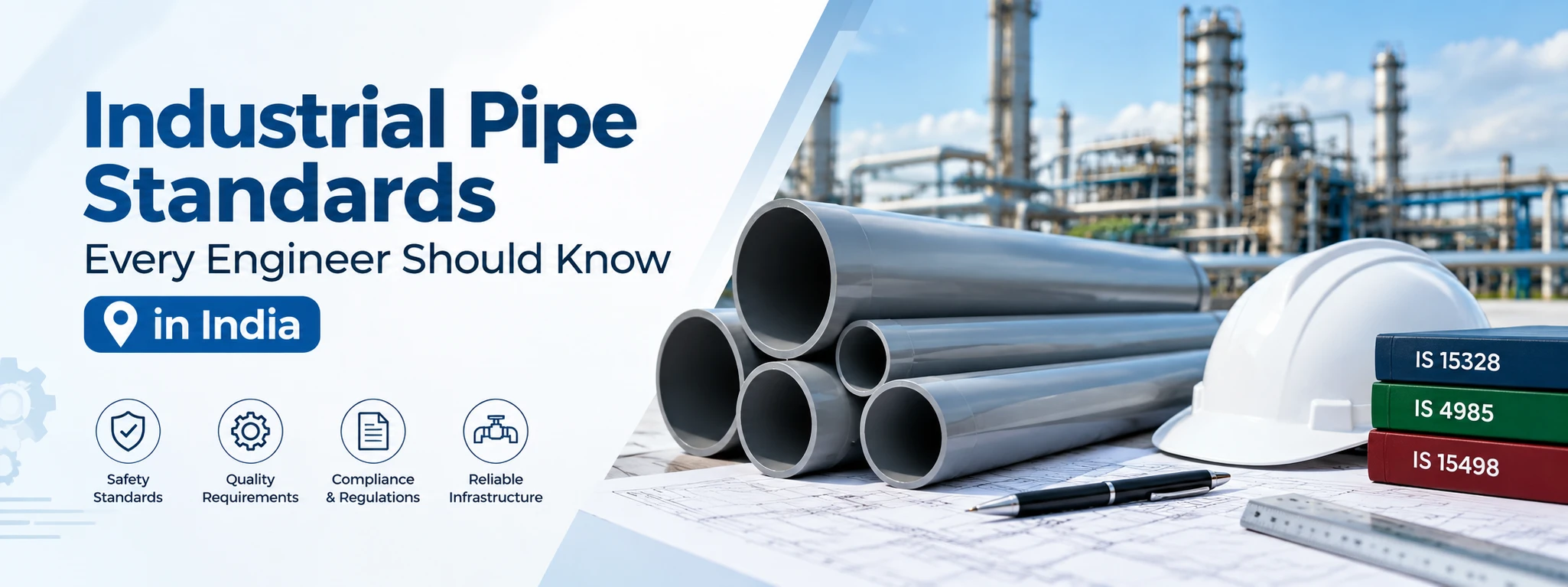
Have you ever wondered why one project specifies an IS standard while another refers to ASTM, ASME, or API? With so many industrial pipe standards available, understanding which one applies can quickly become confusing. Yet, choosing the right standard is essential for ensuring product quality, regulatory compliance, operational safety, and reliable long-term performance.
This is why we have designed this guide to explains the most important pipe standards in India. Here we discuss industrial pipe standards differ, and what every engineer should know before specifying any industrial pipes and fittings.
Table of Contents
ToggleWhat Are Industrial Pipe Standards?
Industrial pipe standards are recognised technical specifications that define how industrial pipes and fittings should be manufactured, tested, rated, inspected, and evaluated. They establish consistent requirements for:
- Quality to ensure products meet defined manufacturing standards.
- Performance to verify pipes can operate under specified conditions.
- Materials to maintain consistent product specifications.
- Testing to confirm products perform as intended before use.
Together, these pipe standards in India provide a common framework that manufacturers, engineers, contractors, and project owners follow. They use them in designing, specifying, and selecting industrial piping systems.
Why Are Industrial Pipe Standards Important?
Industrial piping systems often operate under demanding conditions. They transport water, chemicals, gases, compressed air, and other process fluids. Many systems also operate under high pressure ratings, varying temperatures, and challenging environmental conditions. Hence, even a small mistake during pipe selection can have serious consequences.
In fact, choosing the wrong material, pressure rating, or product specification may reduce system performance. In some cases, it can even affect operational safety. This is exactly why industrial pipe standards exist. They give engineers a common set of technical requirements instead of relying on assumptions or manufacturer claims alone.
By following recognised standards, engineers can:
- Select industrial pipes and fittings that suit the intended application.
- Verify pressure ratings, temperature limits, and material specifications.
- Ensure compatibility between different pipes, their fittings, valves, and other system components.
- Meet regulatory compliance and industry safety requirements.
- Improve long-term reliability while reducing the risk of premature failures.
- Compare products from different manufacturers using the same technical specifications.
One thing every engineer should remember is that not all standards serve the same purpose. Some define how products should be manufactured and tested. Others provide the engineering codes used to design complete piping systems. Understanding this difference makes it much easier to choose the right standard for every project.
What Types of Industrial Pipe Standards Should Every Engineer Know?
Industrial pipe standards can generally be grouped into four categories. Each category serves a different purpose and helps engineers make informed decisions at different stages of a project. Understanding these categories makes it easier to identify which standard applies during product selection, piping system design, material evaluation, or project compliance.
| Category | Purpose | Examples |
| Product Standards | Define how industrial pipes and fittings should be manufactured, tested, and evaluated. | BIS / IS Standards |
| Design Codes | Provide engineering requirements for designing complete piping systems. | ASME B31.1, ASME B31.3 |
| Material & Testing Standards | Specify material properties, testing methods, and performance evaluation. | ASTM Standards |
| International Standards | Promote internationally recognised specifications and quality frameworks. | ISO, API, DIN/EN |
Let’s understand what each of these categories covers and why engineers rely on them.
What Are Product Standards?
Product standards define the technical requirements that industrial pipes and fittings must meet before they are approved for use. They ensure products are manufactured and tested according to consistent specifications. A typical product standard covers:
- Pipe dimensions and wall thickness.
- Pressure classification.
- Material specifications.
- Manufacturing requirements.
- Product testing and quality requirements.
In India, these standards are developed by the Bureau of Indian Standards (BIS) through various Indian Standards (IS). They help engineers verify that a product is suitable for its intended application and complies with recognised technical specifications.
What Are Design Codes?
Design codes focus on the complete piping system rather than individual products. They guide Specifiers on how a piping system should be designed, installed, inspected, and operated safely. Design codes typically cover:
- Process piping.
- Pressure piping.
- Material selection.
- System layout.
- Inspection requirements.
- Engineering safety practices.
One of the most widely used organisations in this area is the American Society of Mechanical Engineers (ASME). Its engineering codes are commonly followed across power generation, chemical processing, manufacturing plants, oil & gas, and other process industries.
What Are Material and Testing Standards?
Material and testing standards specify how piping materials should be evaluated before they are used. They help specifiers verify that products meet the required quality and performance expectations. These standards commonly define:
- Material specifications.
- Testing methods.
- Strength and durability requirements.
- Dimensional accuracy.
- Performance under specified operating conditions.
The American Society for Testing and Materials (ASTM) develops many of these internationally recognised standards. Engineers frequently use ASTM standards to compare materials, evaluate product quality, and verify compliance with project specifications.
What Are International Standards?
Many industrial projects follow standards that are recognised beyond a single country. These are commonly referred to as international standards. Some of the most widely recognised organisations include:
- ISO – Develops internationally accepted standards for quality, management systems, and technical practices.
- API – Develops standards for the oil, gas, and petrochemical industries.
- DIN – Publishes German engineering standards that are widely referenced in global projects.
- EN – Establishes standards used across European countries.
These standards help improve product compatibility, support international procurement, and ensure greater consistency across multinational engineering projects.
Which Indian Pipe Standards Should Engineers Know?
The Bureau of Indian Standards (BIS) develops Indian Standards (IS) for different types of industrial pipes and fittings used across various applications in India. Since no single standard applies to every pipe, engineers must first identify the pipe material and its intended use. Only then can they determine which Indian Standard the product should comply with.
The table below highlights some of the most widely used pipe standards in India and their primary applications.
| Indian Standard | Covers | Why Engineers Should Know It |
| IS 4984 | HDPE pressure pipes | Used for water supply, irrigation, and industrial water distribution systems. |
| IS 4985 | uPVC pressure pipes | Covers uPVC pipes used for potable water supply under pressure. |
| IS 15801 | PPR piping systems | Applies to PPR pipes and fittings used for hot and cold water applications. |
| IS 15450 | Composite pressure pipes | Covers multilayer composite piping systems used in pressure applications. |
| IS 15778 | CPVC piping systems | Specifies CPVC pipes for hot and cold water distribution. |
| IS 13592 | SWR pipes | Covers PVC-U soil, waste, and rainwater drainage systems. |
| IS 15328 | Underground drainage pipes | Applies to buried non-pressure drainage and sewerage pipelines. |
| IS 7834 | PVC fittings | Covers injection-moulded PVC pipe fittings. |
| IS 8008 | HDPE fittings | Specifies polyethylene fittings used with HDPE piping systems. |
| IS 14735 | SWR fittings | Covers PVC-U injection-moulded fittings for SWR piping systems. |
Understanding these Indian Standards helps engineers specify products with greater confidence. It also makes it easier to compare manufacturers, ensure compliance, and select industrial pipes and fittings that meet the technical requirements of a project.
How Are International Pipe Standards Used in Engineering Projects?
Indian Standards (IS) are widely used for products manufactured and supplied in India. Many engineering projects still also reference international standards. This is particularly common in multinational projects, EPC contracts, export-oriented industries, and sectors such as oil & gas, pharmaceuticals, and chemical processing.
Understanding where each standard is commonly applied helps engineers select the right specifications for their projects.
ASTM Standards
Project teams commonly refer to ASTM standards when:
- Evaluating material specifications and product quality.
- Comparing products from different manufacturers.
- Reviewing testing reports and inspection results.
- Verifying compliance with project specifications.
- Assessing wall thickness, dimensions, and material properties.
ASME Standards
Design teams typically use ASME standards when:
- Designing complete industrial piping systems.
- Developing process piping and pressure piping layouts.
- Determining engineering safety requirements.
- Planning system inspection and operation.
- Working with standards such as ASME B31.3, ASME B31.1, and the ASME B16 Series.
ISO Standards
Procurement teams often reference ISO standards when:
- Evaluating a manufacturer’s quality management practices.
- Procuring products for international projects.
- Ensuring consistency across global supply chains.
- Meeting internationally recognised quality requirements.
- Working on projects involving multiple countries or suppliers.
API Standards
API standards are commonly used for projects involving:
- Oil and gas pipelines.
- Refineries and petrochemical facilities.
- Energy infrastructure.
- High-pressure pipeline systems.
- Petroleum processing and transportation.
DIN and EN Standards
Engineers generally encounter DIN and EN standards when:
- Working on European engineering projects.
- Executing multinational EPC contracts.
- Following European client specifications.
- Procuring products for international infrastructure projects.
- Ensuring compatibility with European engineering practices.
Understanding where these standards are applied makes it much easier to interpret project specifications and select compliant industrial pipes and fittings. It also helps project teams and engineers to avoid specification errors and build piping systems that meet both technical and regulatory requirements.
Conclusion
Industrial pipe standards do much more than define technical specifications. They provide a common framework for selecting, manufacturing, testing, and designing piping systems that are safe, reliable, and fit for their intended application. Understanding these standards also makes it easier to specify the right products, simplify procurement, and build piping systems that deliver reliable long-term performance.
However, even the right standard cannot compensate for poor-quality products. Pipes and fittings that fail to meet recognised standards can affect system performance, increase maintenance requirements, and lead to costly failures over time.
That is why choosing a trusted manufacturer is just as important as understanding the standards themselves. At KPT Pipes, we manufacture high-quality industrial pipes and fittings that are designed to meet relevant Indian Standards. We are known to deliver consistent quality, reliable performance, and long-term durability across a wide range of industrial applications.
FAQs
Q1. What are the different types of industrial pipes?
Ans: Industrial pipes are available in different materials to suit specific applications. Common types include uPVC, CPVC, HDPE, PPR, composite, steel, stainless steel, and ductile iron pipes.
Q2. What is an industrial pipe fitting?
Ans: An industrial pipe fitting is a component used to connect, redirect, control, or terminate sections of a piping system.
Q3. What are the three main types of pipe fittings?
Ans: Pipe fittings are generally grouped into three categories based on their function:
- Direction-changing fittings such as elbows and bends.
- Branching fittings such as tees and crosses.
- Connecting or reducing fittings such as couplings, unions, reducers, and adapters.
Q4. Which company’s CPVC pipe is best?
Ans: There is no single CPVC pipe brand that is best for every application. The right choice depends on factors such as product quality, compliance with relevant Indian Standards, pressure rating, application requirements, and the manufacturer’s quality control practices.
Q5. Which industrial pipe standard is most commonly used in India?
Ans: There is no single standard that applies to every industrial pipe. Different materials follow different Indian Standards. For example, IS 4985 applies to uPVC pressure pipes, IS 15801 covers PPR piping systems, and IS 15450 applies to composite pressure pipes. The correct standard depends on the pipe material and its intended application.