
Have you ever wondered how much rainwater a building could lose simply because it has no proper way to carry it from the rooftop to a storage tank or recharge structure?
According to the National Water Mission’s rainwater harvesting guidance, a 100 m² rooftop receiving 1,000 mm of annual rainfall can yield around 80,000 litres of rainwater a year, assuming a runoff coefficient of 0.8 for a pucca roof. That’s 80 tonnes of water that could be put to use instead of flowing away.
But collecting rainwater is only half the job. The water must also reach its intended destination. This is where SWR pipes and fittings become essential, carrying rooftop runoff through the drainage network towards storage or groundwater recharge. Let’s explore why these pipes are the backbone of modern rainwater harvesting systems and what makes them suitable for the job.
Table of Contents
ToggleWhy Are SWR Pipes Essential to Rainwater Harvesting Systems?
Imagine a building that collects rainwater from its rooftop but has no suitable route to carry it to a storage tank or recharge structure. Depending on the drainage arrangement, water may overflow from collection points, discharge near the foundation, or flow away without being harvested.
This is where SWR pipes for rainwater harvesting play a fundamental role. Designed for non-pressure drainage, suitable SWR pipe systems carry rooftop runoff under gravity towards its intended destination.
Here is how they contribute to the process.
- Collecting rainwater from the rooftop: Rainwater flows across the roof towards the designated outlets, where it enters the drainage network.
- Carrying runoff through the building’s drainage system: SWR pipes carry the collected water down from the rooftop. Suitable pipe sections and fittings connect the route according to the building’s layout.
- Directing water towards its destination: The pipe network carries rainwater towards a storage tank or a properly designed groundwater recharge structure, depending on the harvesting system.
- Making rainwater collection possible: With a suitable conveyance route in place, rainwater can reach the intended destination instead of flowing away without being collected.
But couldn’t any pipe carry rainwater from the rooftop to a storage tank or recharge structure? What makes SWR pipes stand out and why should you consider them for your rainwater harvesting system? Let’s explore why SWR pipes and fittings are an ideal choice for rainwater harvesting systems.
Why SWR Pipes Excel in Rainwater Harvesting
SWR pipes are well suited to rainwater harvesting because they offer corrosion resistance, smooth internal surfaces, and compatible fittings that help carry rooftop runoff to its intended destination. Their lightweight construction also makes installation easier, while properly designed joints help reduce leakage along the route.
Let’s look at how each of these features contributes to a more effective rainwater harvesting system.
1. Smooth Internal Surfaces Help Maintain Water Flow
Rainwater collected from a roof can carry dust, small particles, and other debris into the drainage network. SWR pipe fittings have a smooth internal surface that reduces resistance to water flow and can limit the accumulation of deposits along the pipe walls. This helps water move through the system without unnecessary restrictions.
2. uPVC Resists Corrosion in Drainage Applications
Unlike susceptible metal pipes, uPVC SWR pipes resist rust and corrosion under normal service conditions. This makes them a practical option for building drainage networks where corrosion resistance is important.
3. Secure Joints and Fittings Help Direct Rainwater
SWR pipes can be connected using the jointing system specified for the product, with compatible fittings used to change direction or connect pipe sections. This allows the pipe network to follow the building’s layout and carry rooftop runoff towards a storage tank or recharge structure. Properly installed joints also help prevent leakage, reducing the risk of losing collected rainwater along the route.
4. Lightweight Construction Simplifies Installation
SWR pipes made from uPVC are relatively lightweight, making them easier to handle, position, and support during installation. This can be useful when installing rainwater downpipes along walls or connecting drainage lines around a building. Their range of fittings also allows the network to accommodate changes in direction and different connection points.
Each feature of SWR Pipes and Fittings for rainwater harvesting contributes to a different aspect of rainwater conveyance, as summarised below.
How SWR Pipe Features Support Rainwater Harvesting
| SWR pipe feature | Why it matters for rainwater harvesting |
| Smooth internal surface | Reduces resistance to water flow, helping rooftop runoff move through the pipe network. |
| Corrosion-resistant uPVC | Resists rust and corrosion under suitable service conditions, making it a practical option for rainwater drainage. |
| Secure joints and suitable fittings | Help connect pipe sections, accommodate changes in direction, and reduce leakage risks when correctly installed. |
| Lightweight construction | Makes pipes easier to handle and position when installing rooftop downpipes and connecting drainage sections. |
| Suitability for outdoor exposure | Helps ensure exposed pipes are appropriate for sunlight and weather conditions, depending on the product’s specifications. |
Why Choose KPT Pipes’ Drainmate for Rainwater Harvesting?
When you invest in a rainwater harvesting system, you want every component to do its job properly. The pipes must carry rooftop runoff where it needs to go, the connections must suit your layout, and the system must work as intended. Choosing the right SWR Pipes and Fittings for Rainwater Harvesting is an important part of getting these details right.
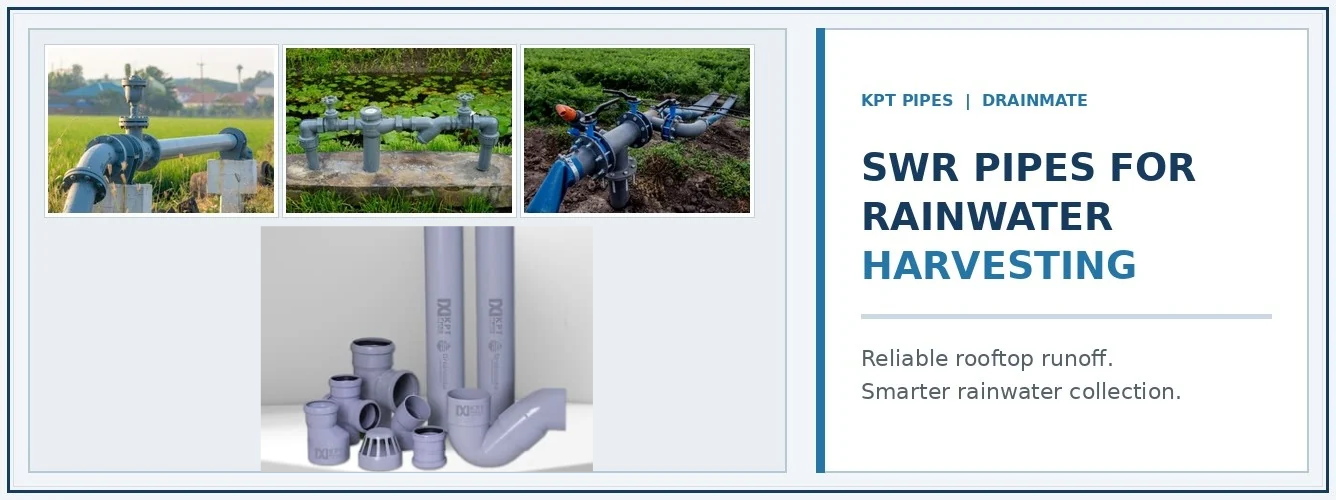
At KPT Pipes, we understand that different buildings have different drainage requirements. That is why our Drainmate range offers uPVC SWR pipes and fittings for soil, waste, rainwater, and drainage applications. The range gives customers options to consider based on their project’s layout and requirements.
Drainmate: Designed Around Practical Drainage Needs
- Smooth internal surfaces: Drainmate pipes have smooth inner walls that support water flow. This helps rooftop runoff travel through the drainage network, although regular cleaning remains essential to prevent debris-related blockages.
- Resistance to corrosion: Our uPVC SWR pipes resist rust and corrosion under suitable service conditions, making them a practical choice for building drainage systems.
- Options for different layouts: Drainmate offers Type A and Type B pipes in sizes ranging from 75 mm to 160 mm, along with fittings and Selfit and Ringfit jointing options. This variety helps customers assess combinations suited to their installation requirements.
Choosing a pipe is not simply about finding one that fits. It is about finding a system that works with your building and the volume of water it needs to carry.
Explore KPT Pipes’ Drainmate SWR Pipes and Fittings to discover the available options for your rainwater harvesting project.
FAQs
1. How do you choose the right SWR pipe size for rainwater harvesting?
The right pipe size depends on the rooftop area, local rainfall intensity, and the number of outlets feeding the drainage system. These factors help determine how much rainwater the pipes need to carry during heavy rainfall.
2. Can rainwater collected through SWR pipes be used for household purposes?
Yes, rainwater collected through SWR pipes can be directed to a storage tank for suitable uses, but the pipes do not make the water safe to use. You still need the required filtration and treatment depending on how the water will be used.
3. How can you prevent blockages in SWR pipes used for rainwater harvesting?
Leaves, dust, and other debris can enter the drainage system with rooftop runoff. Keeping roof outlets clear, checking screens, and inspecting the pipes periodically helps prevent blockages and maintain water flow.