
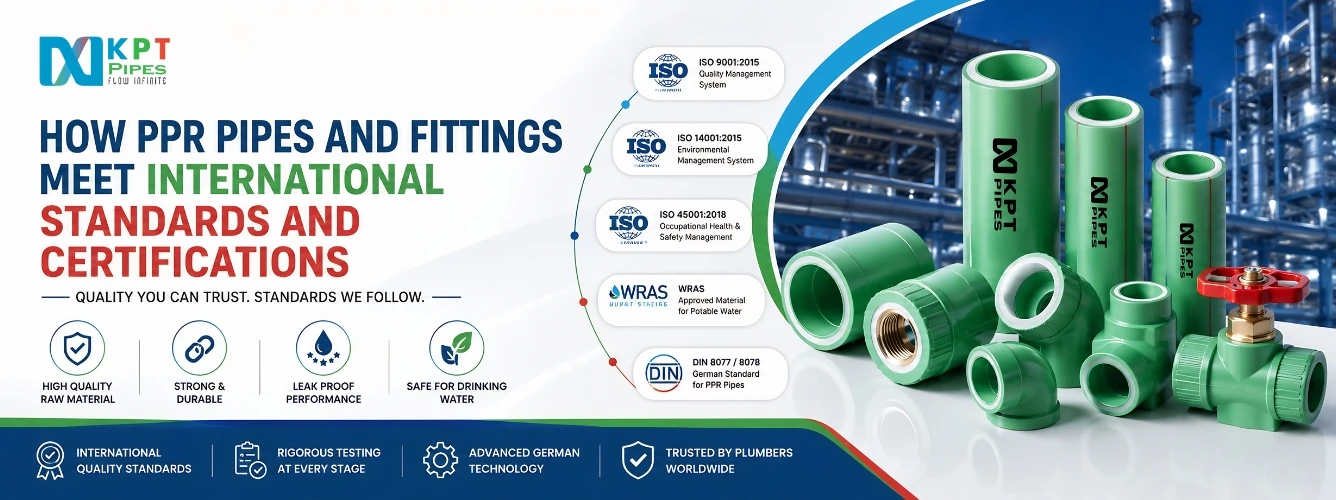
In today’s modern plumbing and piping industry, quality, durability, and safety are among the most important factors when selecting pipes and fittings for residential, commercial, and industrial projects. Among the various piping solutions available in the market, PPR pipes and fittings have become one of the most trusted choices due to their excellent performance, long service life, and high resistance to pressure and temperature. However, what truly makes PPR pipes reliable is their ability to meet international standards and certifications that ensure safety, consistency, and superior quality.
International certifications are essential because they guarantee that the pipes have been tested under strict conditions and comply with globally accepted manufacturing and performance guidelines. Whether used in hot and cold water systems, industrial fluid transportation, or fire safety applications, certified PPR pipes provide confidence to builders, contractors, engineers, and homeowners.
Table of Contents
ToggleUnderstanding the Importance of International Standards
International standards are designed to ensure that piping systems perform efficiently under different environmental and operational conditions. These standards define the quality of raw materials, manufacturing processes, pressure-bearing capacity, dimensional accuracy, and overall product safety.
When PPR pipes and fittings comply with these certifications, they have undergone rigorous testing for durability, thermal and chemical resistance, and leak prevention. This ensures that the piping system remains safe and functional for years without frequent maintenance or replacement.
Certified pipes also reduce the risk of system failure, water contamination, and pressure-related damage. For industries and infrastructure projects, compliance with international standards is often mandatory to ensure long-term reliability and operational safety.
High-Quality Raw Materials Ensure Reliable Performance
One of the major reasons certified PPR pipes achieve global acceptance is the use of premium-grade polypropylene random copolymer material. International standards require manufacturers to use high-quality raw materials that can withstand varying temperatures and pressure conditions.
Superior raw materials provide multiple advantages, including:
- Excellent resistance to corrosion and scaling
- Long-lasting durability under continuous pressure
- Better thermal insulation properties
- Safe transportation of drinking water
- Reduced chances of leakage or cracking
High-grade PPR material also prevents chemical reactions with water, making the pipes suitable for potable water applications. This is particularly important in residential and commercial buildings where hygiene and water safety are critical.
Pressure and Temperature Resistance Testing
PPR pipes are widely known for their ability to handle both hot and cold water systems efficiently. International certifications require these pipes to undergo extensive pressure and temperature testing before approval.
Certified PPR pipes are tested under extreme conditions to evaluate their:
- Pressure-bearing capacity
- Thermal expansion behavior
- Resistance to high temperatures
- Long-term performance under continuous load
- Joint strength and leak-proof capability
These tests ensure that the pipes can function efficiently in demanding environments such as industrial plants, hospitals, hotels, and multi-story buildings.
Because of their strong molecular structure, certified PPR pipes can maintain stable performance even in fluctuating temperatures, making them ideal for modern plumbing systems.
Hygienic and Safe for Drinking Water Applications
One of the most important requirements for plumbing systems is maintaining water purity. International certifications verify that PPR pipes are non-toxic and safe for drinking water transportation.
Unlike traditional metal pipes, PPR pipes do not rust, corrode, or release harmful substances into the water. Their smooth internal surface also prevents bacterial growth, scaling, and sediment buildup.
Certified PPR pipes help maintain water quality by offering:
- Odour-free water flow
- No chemical contamination
- Resistance to microbial growth
- Smooth and hygienic internal surfaces
- Safe long-term water transportation
These features make PPR pipes a preferred solution for residential complexes, healthcare facilities, schools, and commercial buildings.
Leak-Proof Jointing Technology
One of the biggest advantages of PPR pipes and fittings is their heat fusion jointing system. International standards evaluate the strength and reliability of these joints to ensure long-term leak-proof performance.
During installation, the pipe and fitting are fused together using heat welding, creating a homogeneous connection. This process eliminates weak points and significantly reduces the risk of leakage.
Certified fusion joints provide:
- Strong and permanent connections
- Minimal maintenance requirements
- Better pressure resistance
- Reduced water wastage
- Enhanced system reliability
This advanced joining technology is one of the reasons why PPR piping systems are considered more durable than conventional plumbing solutions.
Resistance to Corrosion and Chemicals
Traditional metallic pipes often face corrosion problems over time, especially in areas with aggressive water conditions or chemical exposure. Internationally certified PPR pipes are tested for their resistance to corrosion, acids, alkalis, and other chemicals.
Their non-reactive nature makes them highly suitable for industrial applications where chemical transportation is required. Even in residential plumbing systems, corrosion-resistant pipes help maintain smooth water flow and extend system life.
The corrosion-resistant properties of certified PPR pipes offer benefits such as:
- Longer operational life
- Lower maintenance costs
- Improved flow efficiency
- No rust formation
- Better performance in harsh environments
This durability helps reduce replacement frequency and makes PPR piping systems a cost-effective long-term investment.
Dimensional Accuracy and Manufacturing Precision
International certifications also focus on manufacturing precision and dimensional consistency. Pipes and fittings must maintain exact dimensions to ensure proper installation and compatibility.
Certified manufacturers use advanced production technologies and automated quality control systems to maintain uniform thickness, diameter, and structural strength.
Accurate dimensions ensure:
- Easy installation
- Proper fitting compatibility
- Reduced leakage risks
- Improved pressure handling
- Consistent system performance
This precision becomes especially important in large-scale construction and industrial projects where reliable piping infrastructure is essential.
Fire Safety and Thermal Efficiency
Modern PPR piping systems are also designed to support fire safety and thermal insulation requirements. Specialised PPR-FR pipes are manufactured for fire-fighting applications and are tested according to strict international fire safety standards.
Additionally, PPR pipes have low thermal conductivity, which minimises heat loss in hot water systems. This improves energy efficiency and reduces operational costs.
Their thermal properties provide:
- Better heat retention
- Reduced energy consumption
- Safe hot water transportation
- Enhanced fire safety performance
- Improved system efficiency
These qualities make certified PPR pipes suitable for modern green buildings and energy-efficient infrastructure.
Why Certifications Matter in Construction Projects
Builders, architects, and engineers prefer certified PPR pipes because certifications act as proof of quality and reliability. International standards ensure that every pipe and fitting delivers consistent performance under real-world conditions.
Using certified piping systems helps projects achieve:
- Higher safety standards
- Better plumbing efficiency
- Long-term durability
- Reduced maintenance expenses
- Compliance with construction regulations
In large infrastructure projects, certified products also improve trust among contractors and project owners.
Conclusion
PPR pipes and fittings have transformed modern plumbing systems by offering durability, hygiene, thermal resistance, and long-term reliability. Their compliance with international standards and certifications ensures that they meet strict quality and safety requirements for residential, commercial, and industrial applications.
From pressure testing and leak-proof jointing to corrosion resistance and hygienic water transportation, certified PPR pipes deliver superior performance in every aspect. As construction standards continue to evolve globally, the demand for high-quality certified PPR piping systems is expected to grow even further.